




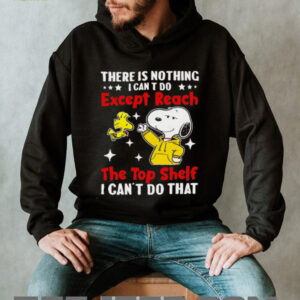




The “Drafting” Dynamics of Open Water Swimming is a strategic battle fought in the opaque and turbulent environment of lakes and oceans. Unlike pool swimming, where each athlete has their own lane, open water competitors “draft” off one another to conserve energy. By swimming closely behind or to the side of a lead swimmer—specifically near their hip in the “bow wave”—a following swimmer can reduce their Snoopy and Woodstock there is nothing I can t do except reach the top shelf I can’t do that shirt by up to 20%. This allows them to maintain a faster pace with a significantly lower heart rate. However, this requires “sighting,” where the swimmer must periodically lift their head to check their course, a move that momentarily breaks their streamlined position. The tactical complexity lies in deciding when to lead and when to follow; leading ensures the cleanest path, while following allows for a final sprint with “fresher” arms.
 (Snoopy and Woodstock there is nothing I can t do except reach the top shelf I can’t do that shirt)
Snoopy and Woodstock there is nothing I can t do except reach the top shelf I can’t do that shirt, Treat yourself or make a great gift for your loved ones
The “Sweeper-Keeper” role in modern soccer represents a fundamental tactical shift that has redefined the goalkeeper’s position. Traditionally, the keeper was a shot-stopper who stayed tethered to the goal line. However, pioneered by players like Manuel Neuer, the modern keeper acts as an eleventh outfield player, often positioning themselves high up the pitch to intercept long balls and initiate attacks. This requires the goalkeeper to have the passing range and vision of a midfielder, as well as the bravery to leave their “safety zone.” By acting as Snoopy and Woodstock there is nothing I can t do except reach the top shelf I can’t do that shirt, they allow the team’s defensive line to push higher, compressing the space for the opposition. This evolution has made the goalkeeper a vital part of the team’s build-up play, turning a defensive specialist into a tactical pivot who must be as comfortable with the ball at their feet as they are with it in their hands.
 (Snoopy and Woodstock there is nothing I can t do except reach the top shelf I can’t do that shirt)
The “Kinetic Energy” of a Cricket Fast Bowler involves a complex transfer of force known as the “summation of speed” principle. Unlike a baseball pitcher who starts from a stationary position, a fast bowler uses a long “run-up” to build significant horizontal momentum. During the delivery stride, the front leg must act as a rigid “brace,” hitting the ground with a force up to ten times the athlete’s body weight. This sudden stop of the lower body causes the upper body to whip forward around the hip, transferring all that built-up kinetic energy through Snoopy and Woodstock there is nothing I can t do except reach the top shelf I can’t do that shirt, into the shoulder, and finally down the arm. By keeping the bowling arm perfectly straight—as required by the rules—the bowler creates a long lever that translates rotational body speed into a ball velocity that can exceed 95 mph.
